
Identification assistance
Cultivar Trait Selection Guide
Use this guide when choosing trait and characteristic values on cultivar records or the Identification Assistance page. A plumeria cannot be positively identified from one or two traits. DNA testing would be the only true positive identification method when it becomes practical for plumeria.
Until then, the best approach is to compare a candidate plant with known cultivars across all observable traits, photos, source notes, and growing context.
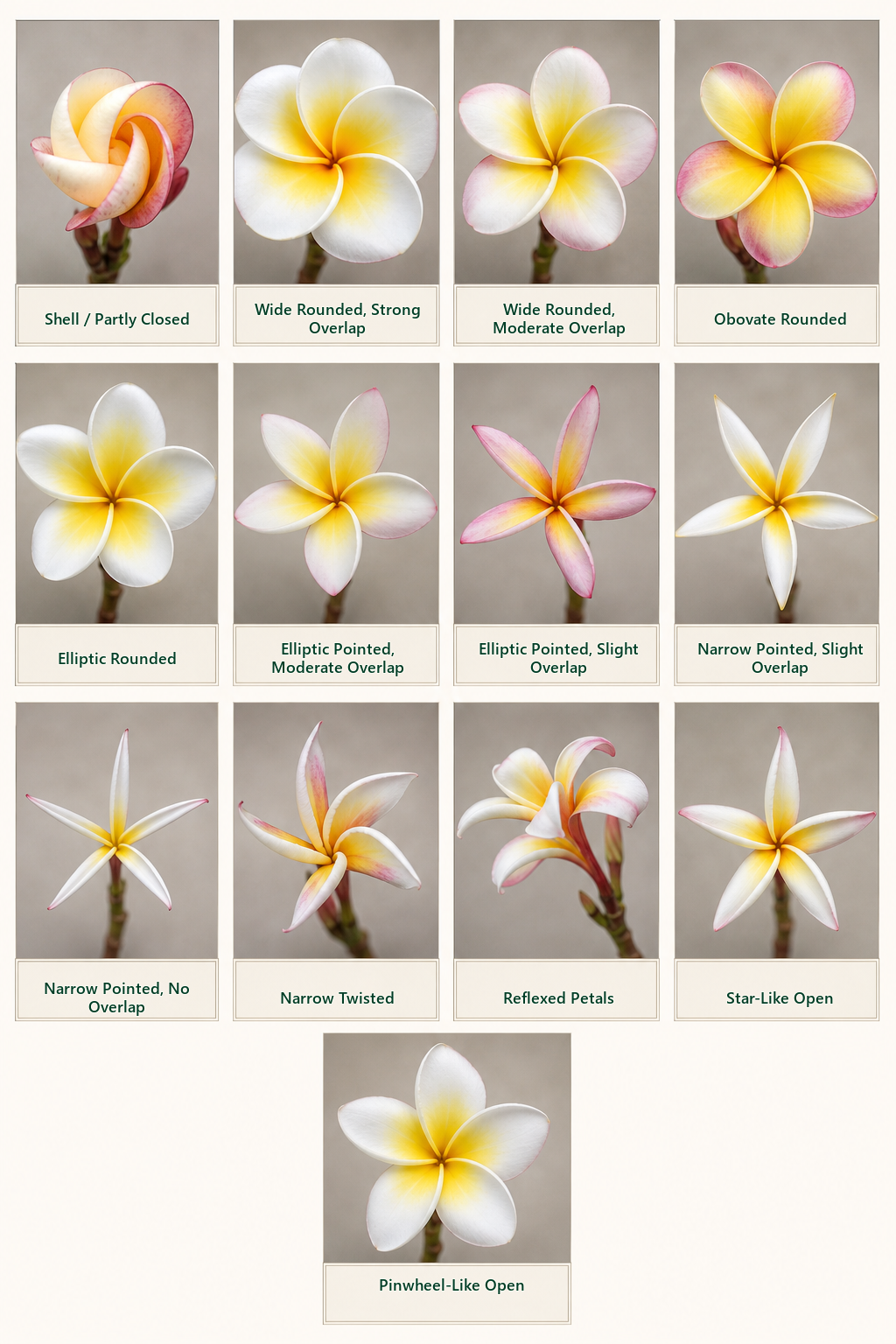
Flower
Flower traits are usually the first things people notice, but they are also the easiest to misread. Color can change with sun exposure, flower age, temperature, camera settings, and season.
How to choose flower color
- Look at several fully open flowers, not just one bloom.
- Use a bloom that opened recently and has not faded heavily in strong sun.
- Choose the main petal color or colors for the outer petals. Do not count the center color as the primary flower color.
- If the petals clearly show more than one dominant color, select multiple colors or a multicolor/blended value when available.
- If the flower changes color between cool and hot weather, note that in color behavior or verifier notes rather than forcing one value.
How to choose center color
- Look only at the eye, throat, or center area where the petals meet.
- Choose the center color even if that same color also appears elsewhere on the petal.
- If the center is not distinct, use No Distinct Center or mark it for review.
How to choose flower size
- Measure a fully open bloom across its widest point.
- Measure more than one bloom if possible.
- If blooms vary, use the closest range rather than a single exact size.
- Do not estimate from a cropped photo unless there is a reliable size reference.
How to choose color pattern and reverse traits
- Use color pattern for how color is arranged on the flower face, such as solid, blended, banded, edged, striped, veined, starburst, speckled, or mottled.
- Record reverse color only from a clear flower-back photo. Do not guess reverse color from the front of the flower.
- Use face-to-back contrast when the back of the petal is clearly lighter, darker, redder, yellower, or otherwise different from the flower face.
- Use color confidence when the source of the color is important: expert verified, multiple photos, one photo, reported by a grower, climate variable, questionable photo color, or conflicting reports.
- If color depends strongly on season, bloom age, sun exposure, or temperature, record that as color behavior or photo context instead of forcing a single simple color value.
How to choose flower form
- Use flat/open, cupped, shell, semi-shell, reflexed, incurved, twisted, pinwheel, star-shaped, round, or overlapping only when that is the normal form for several typical blooms.
- Use poor opening when flowers consistently fail to open normally, not for one damaged or weather-affected bloom.
- Use flower symmetry when the open flower is consistently balanced, mostly symmetrical, slightly irregular, irregular, or variable.
- When a flower changes form with heat, cool weather, rain, or age, add a note or mark the form for review.
Best evidence: several clear flower photos from different days, with notes for date, region, season, sun exposure, and whether the bloom was newly opened or aged.
Fragrance
Fragrance is helpful, but it is subjective and can change by time of day, humidity, heat, flower age, and the person smelling it.
- Smell more than one bloom on the same plant.
- Check at different times of day if possible, especially morning and warm afternoon.
- Choose the strength first: none, light, mild, moderate, strong, or heavy.
- Then choose scent character only if it is clear, such as classic plumeria, sweet, citrus, jasmine, rose, coconut, peach, spicy, grape, lemon, or musk.
- If two trusted observers disagree, use a softer value or mark it for review.
Tree
Tree traits should be based on an established plant when possible. Young cuttings, recently rooted plants, and plants grown in pots can look different from mature landscape specimens.
Bloom
Bloom habit describes how the cultivar performs over time, not whether one photo shows flowers.
- Use rare or occasional bloomer only when repeated observations support it.
- Use good, heavy, or exceptional bloomer when the plant regularly blooms well under normal care.
- Use early bloomer or late bloomer only when bloom timing is known compared with other cultivars in the same growing area.
- Use reliable bloomer when performance is consistent across seasons or trusted reports.
- Do not confuse a single strong inflorescence with heavy blooming habit.
Seed / Reproduction
Seed setting should be recorded from observed pods or trusted source notes. Many cultivars may set pods in one climate and not another.
- Record none observed only when the source is clear that pods have not been seen.
- Use rare, occasional, or reliable seed setting only when there are repeated observations.
- Use single pod or paired pods when the pod form is visible or documented.
- Do not infer seed-setting behavior from parentage alone.
- List known seedlings on the cultivar record when the parent relationship is supported by a source.
Propagation
Propagation traits describe how a cultivar behaves when grown from cuttings or grafts. These values should come from grower experience, not from a single newly rooted plant.
- Use rooting difficulty only when multiple cuttings or trusted grower reports support the value.
- Choose rooting speed from repeated observation, such as fast, average, slow, or very slow.
- Record cutting success only when the grower has enough attempts to judge the cultivar fairly.
- Use grafting difficulty when the cultivar has known compatibility, vigor, or aftercare issues.
- If the only source is one successful cutting or one failed cutting, mark the trait for review instead of treating it as final.
Propagation behavior can change with season, cutting maturity, heat, humidity, media, sanitation, and grower method.
Petal Shape / Type
Petal shape should be judged from a front-facing, fully open flower. One distorted bloom is not enough.
- Look at several typical blooms from the same plant.
- Choose shape based on the petal outline: elliptical, obovate, spatulate, round, narrow, wide, or overlapping.
- Use twisted, reflexed, incurved, shell, semi-shell, ruffled, or wavy only when that form is typical, not occasional.
- Use star-shaped when the bloom consistently reads as a star form from the front.
- If the photo angle hides the petal form, mark the trait for review.
Petal Surface / Color Behavior
This section captures texture and how the flower behaves in sun, heat, cool weather, and age.
- Choose smooth, velvety, grainy, waxy, thin, medium substance, or thick petals from close photos or direct observation.
- Use fades in sun when color noticeably washes out after exposure.
- Use holds color well when blooms keep their color even after sun exposure.
- Use intensifies in heat when warmer conditions make the color stronger.
- Use darkens in cool weather when cooler conditions deepen the color.
- Use strong veining, color bands, splash, or streaks only when the pattern is a normal cultivar feature.
Photo context is important here. A photo date, season, region, sun exposure, and approximate temperature can explain why the same cultivar looks different in different photos.
Inflorescence
Inflorescence traits describe the flower cluster and stalk, not the individual flower. These traits are useful, but they require clear photos of the whole bloom cluster.
- Use inflorescence height only when the flower stalk can be seen from the branch to the bloom cluster.
- Estimate flowers open at once from a clear cluster photo or direct observation, not from a cropped single-flower image.
- Record stalk color only when lighting is reliable and the stalk is visible.
- Record stalk texture only when the photo is close enough to show smooth, rough, or pubescent surface detail.
- If only individual flower closeups are available, mark inflorescence details for review.
Leaves
Leaf traits are useful when flower traits are not enough, but they should be taken from healthy mature leaves. Stressed, pest-damaged, nutrient-deficient, or newly emerging leaves can mislead the record.
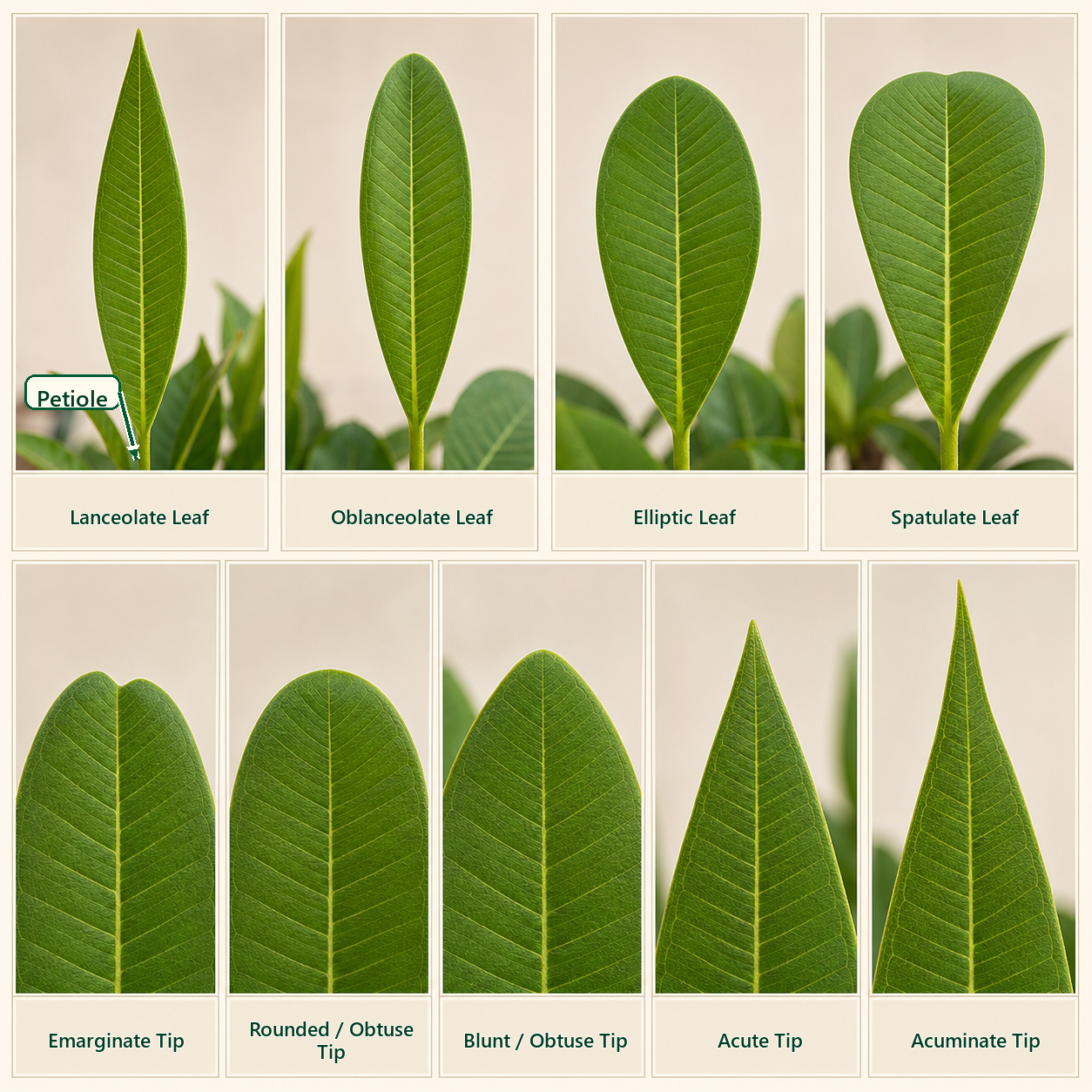
- Use mature leaves from normal growth, not tiny new leaves or old damaged leaves.
- Choose size only if the plant is healthy and the leaf size is typical.
- Choose shape terms such as narrow, wide, oblanceolate, or elliptic from the overall leaf outline.
- Choose glossy, matte, dark green, medium green, or light green only when lighting is reliable.
- Use acuminate tips, rounded tips, or prominent veins when those features are clearly visible.
- Check petiole length on several mature leaves before choosing short, medium, or long.
- Choose petiole color only when the stalk color is clearly visible; new growth, sun exposure, and stress can change the apparent color.
- If the leaf photo is poor or the plant was stressed, mark the trait for review instead of choosing a value.
Petiole
The petiole is the short stalk between the leaf blade and the branch. Petiole length and color can help compare cultivars, but the observation should come from mature, healthy leaves and more than one leaf when possible.
- Check several mature leaves from normal growth before choosing short, medium, or long petiole length.
- Record petiole color only when the stalk is clearly visible and lighting is reliable.
- Do not use stressed, sunburned, pest-damaged, or very young leaves for petiole color decisions.
- If petiole length or color varies strongly across the plant, mark it for review or describe the range.
Origin / Source
Origin and source notes explain where a cultivar is reported to have come from and how the record information is supported. These fields are research context, not visual proof of identity.
- Use country of origin only when the source is clear and applies to the cultivar, not merely to a nursery selling it.
- Keep origin, introducer, nursery line, and collection notes separate when possible.
- Record parentage and known seedlings only when the source supports the relationship.
- If a detail is reported but not verified, mark it as reported or needs review rather than treating it as confirmed.
- Use AKA names carefully; spelling differences, quoted names, and marketing names should not automatically create separate cultivars.
AKA, Parentage & Known Seedlings
This section records name history and relationship notes. It helps reviewers understand how a cultivar has been listed, where it may have come from, and which seedlings are reported to descend from it.
These details are important for research, but they are not visual identification proof by themselves. Alternate names, parentage, and seedling claims should be treated as reported information until they are supported by a trusted source.
How to separate name history from proof
- Use Also Known As for names that may point to the same cultivar, but do not treat an AKA as proof unless the source clearly connects the names.
- Use Original Name when the earliest known name is documented. If the record only shows a later sales name, leave the original name blank or mark it for review.
- Use Seedling of / Parentage for reported lineage such as “Seedling of White Shell.” This tells reviewers what has been reported; it does not prove identity by itself.
- Use Pod Parent and Pollen Parent only when the cross is specifically documented. If a source says “seedling of Camelot” but does not identify the pollen parent, do not invent one.
- Use Known Seedlings for named descendants, not seedlings that merely came from the same grower, batch, or collection.
Why this matters: name history helps prevent duplicate records and preserves breeder or nursery history, but visual traits, source notes, and photo evidence still need to agree before a record is treated as strong.
How to review these fields
- Keep spelling variations and true alternate names together so visitors do not mistake them for separate cultivars without evidence.
- Do not merge two cultivar records based only on a similar name. Compare source history, photos, traits, and trusted references first.
- Mark parentage as reported when the source is credible but not fully verified.
- Use review notes when different sources disagree about AKA names, parentage, originator, introducer, or known seedlings.
- When a name or relationship claim is accepted, keep enough source context so a future reviewer understands why it was accepted.
Best evidence: original nursery notes, breeder notes, registry records, labeled source photos, catalog references, or consistent records from trusted collectors and growers.
Photo Context
Photo context helps explain why the same cultivar may look different in different pictures. Sun exposure, bloom age, heat, cool weather, season, camera settings, and region can all affect visible color and form.
- Record the date, time of day, region, and photographer credit whenever known.
- Note whether the photo shows a newly opened bloom, mature bloom, or aged/fading bloom.
- Include sun exposure and approximate temperature when available, especially for cultivars that fade or intensify with heat.
- Use photo-observed traits as clues, not final proof, unless the photo identity and context are trusted.
- When the photo source is uncertain, mark the photo for review before using it as a reference image.
Best evidence: several verified photos from the same cultivar showing the flower front, flower back, center, leaf, plant habit, and seasonal color behavior, with credit and permission preserved.
Photo Documentation
Each photo should document a specific feature. A beautiful flower photo is useful, but a complete cultivar record also needs flower backs, centers, leaves, plant habit, seed pods, roots, and review-control images when available.
How to judge photo quality
- Use Verified Photo only when the cultivar identity is trusted.
- Use Questionable Photo when the image may be useful but identity, color, or context needs review.
- Use Incorrect Photo or Hidden / Do Not Use when the image should not guide identification.
- Use color accuracy notes for oversaturated, underexposed, artificial-light, shade, full-sun, or otherwise misleading images.
- Record photographer, date, region, and permission whenever known.
Photo Submissions
Photos are most useful when they include context. A photo submitted to Plumeria Database should include the cultivar name, date taken, time of day, region, and photographer credit. The submitter must either have taken the photo or have permission from the original photographer.
- Choose the closest photo group before submitting, such as Flower, Leaf, Tree / Habit, Seedpod, Cutting / Rooting, ID Reference, or Other.
- If you are logged in, your name and email may be filled in automatically. Always review them before submitting.
- If the form was opened from a cultivar record, the cultivar name, selected photo group, and source record page are carried into the review queue.
- If the photo was taken by someone else, credit the photographer and explain that you have permission to submit it.
- If date, time, or region are unknown, do not guess. Add a reviewer note explaining what is missing.
Submitting a photo gives Plumeria Database permission to use it on the website and in related publications, and to crop, resize, or make reasonable display adjustments while preserving the cultivar reference purpose.
Expert Review
Expert review fields are not meant to make a record look finished. They show how strong the evidence is and what action should happen next.
- Use high confidence when the correction is supported by trusted records, clear photos, or direct expert knowledge.
- Use medium confidence when the suggestion is likely but still needs another source or photo comparison.
- Use low confidence when the suggestion is a possibility, not a conclusion.
- Use needs additional evidence when the record should stay open until better photos, source notes, or grower observations are available.
- Use conflicting evidence when two or more credible sources disagree.
Accepting a suggestion should move it into the review workflow. It should not silently change cultivar data without a reviewer decision and a source note.
Registration References
The Plumeria Society of America, Inc. is the official source for plumeria registration information. Plumeria Database can help organize cultivar records, photos, and comparison traits, but it is not the official registry.